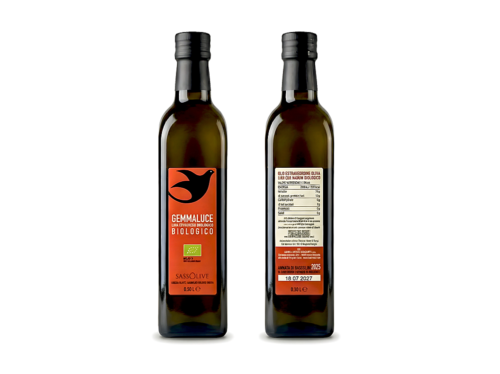
You are standing in the supermarket in front of the olive oil shelf, surrounded by dozens of bottles and canisters. Golden labels, green bottles, Italian flags, enticing terms like “Premium,” “cold-pressed,” or “extra virgin.” But which olive oil is truly good – and which is just well marketed?
The honest answer: Recognizing good olive oil in the supermarket is not that easy. Many purchasing decisions are based on assumptions that have little to do with the actual quality of the oil. Color, price, packaging, or a pretty label often say little about the contents. And this is precisely where most mistakes happen.
In this article, you will learn which five common mistakes you should avoid when buying olive oil – and what really matters if you want to recognize good olive oil. At the end, you will find a practical checklist that will make your next shopping trip significantly easier.
Olive oil is one of the most frequently adulterated foods worldwide. That sounds drastic, but it is well documented. Blends from different countries, inferior qualities with embellished labels, or oils that have lost their natural character through refining – all of this can be found on supermarket shelves. The European Union has repeatedly pointed out problems with the labeling and quality of olive oil in recent years.
The legal designation “extra virgin olive oil” guarantees a minimum quality, but says nothing yet about where the olives come from, how fresh the oil is, or how carefully it was produced. Anyone who wants to buy good olive oil must therefore look a little more closely. The good news: With a few simple basic rules, it becomes much easier to separate the wheat from the chaff.
It is not about becoming an olive oil expert. It is perfectly sufficient to know a few criteria – and to avoid the biggest pitfalls. That is exactly what the following sections are about.
One of the most common mistakes when buying olive oil is making a purely price-based decision. Of course, no one wants to pay more than necessary. But with olive oil, a very low price is almost always a warning sign.
The production of high-quality olive oil is labor-intensive: The olives are harvested at the optimal time, often by hand, and processed within a few hours. Harvesting costs alone in countries like Italy, Greece, or Spain make a liter price below five euros for genuine extra virgin olive oil practically impossible – at least if one assumes honest production.
What many do not know: Depending on the variety and region, between five and ten kilograms of olives are needed for one liter of high-quality olive oil. Harvesting, especially on steep slopes or in traditional groves, is labor-intensive and often only possible with manual work. Added to this are the costs for rapid processing at the mill, quality controls, and proper storage.
This does not mean you always have to buy the most expensive oil. But a reasonable price is a first indication that careful production lies behind the product. As a guideline: Good olive oil generally starts at around eight to ten euros per liter. Anything significantly below that should at least be critically questioned.
Tip: Do not just compare the bottle price, but calculate the price per liter. This way you can recognize more quickly whether an offer is realistic or whether the low price comes at the expense of quality.
Many olive oils in the supermarket bear an Italian flag or a Mediterranean-sounding name, but that says little about the actual origin. Often these are blends from different EU countries – or even from non-EU states. This is legal as long as it is noted on the label. But the phrase “blend of EU olive oils” is often overlooked or underestimated.
The problem with this: When olive oils from different sources are blended, traceability often suffers. The consumer cannot trace under what conditions the olives were grown and harvested, how long the transport took, or when the oil was actually pressed. All these factors significantly influence quality.
Truly good olive oil generally comes from a clearly named region or even from a single producer. The more transparently a producer provides information about origin, olive variety, and harvest time, the higher the quality usually is. Some producers even specify the exact plot or grove from which the olives come.
Look for specific information such as: “Made from Taggiasca olives from Liguria” or “Single estate in Crete.” Such information shows that the producer has nothing to hide – and is proud of their product.
Tip: If there is no specific origin stated on the bottle, this is often a sign that it is an industrial blend. Look specifically for oils with clear regional attribution.
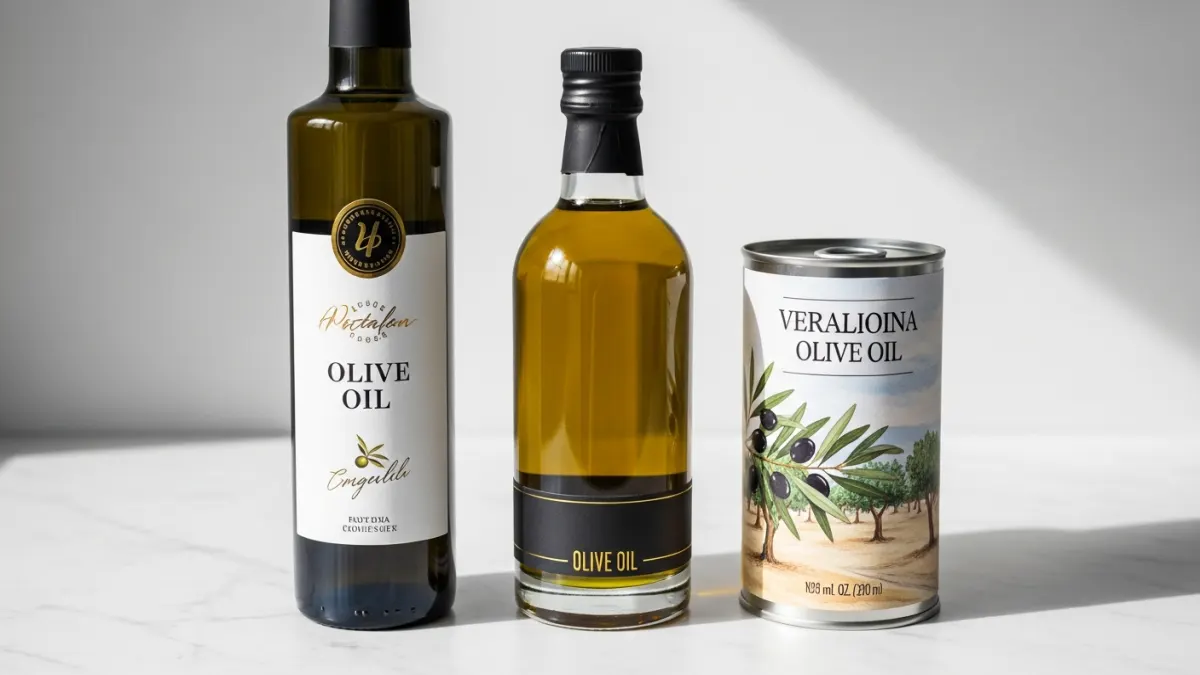
An elegant bottle, an elaborately designed label, perhaps even a wooden box – all of this appears high-quality. But the packaging says surprisingly little about the quality of the olive oil itself. Some of the best olive oils in the world are sold in simple canisters or plain dark bottles. Conversely, some beautifully designed bottles contain industrial mass-produced products.
What the packaging can reveal, however: How well the oil is protected. Olive oil is light-sensitive. UV radiation destroys valuable polyphenols and antioxidants and causes the oil to age faster. Therefore, dark glass bottles or opaque canisters are fundamentally better than clear glass bottles. Tin-plated canisters also offer excellent light protection and are preferred by many small producers.
If you see an olive oil in a transparent bottle in the supermarket that is also standing under neon light, it may have already lost quality – no matter how beautifully the label is designed. Storage on the shelf under artificial light is one of the underestimated quality killers in the supermarket.
Tip: Prefer dark bottles or canisters. Beautiful packaging is not a quality feature – but protective packaging is. Reach toward the back of the shelf, where the bottles have been exposed to less light.
The labels on olive oil bottles can be confusing. Terms like “cold-pressed,” “first pressing,” “Premium,” “Gold,” or “mild and fruity” sound good, but are partly misleading or simply marketing terms without legally defined meaning.
What really counts is the official quality designation. In the EU, there are three main categories:
Only “extra virgin olive oil” guarantees that the oil was produced exclusively through mechanical processes and meets certain sensory quality standards. Anything below that is a compromise – both in terms of taste and health-relevant ingredients.
The term “cold-pressed” is actually superfluous for modern olive oil: Most high-quality oils today are cold-extracted, meaning processed at temperatures below 27°C. This is standard in the production of extra virgin olive oil, not a special quality feature. The same applies to “first pressing” – modern oil mills use centrifuges, so there is no second pressing anymore.
Tip: Look for the official designation “extra virgin olive oil” and do not be dazzled by marketing terms. If a producer advertises with self-evident features, this can be an indication of a lack of genuine quality characteristics.
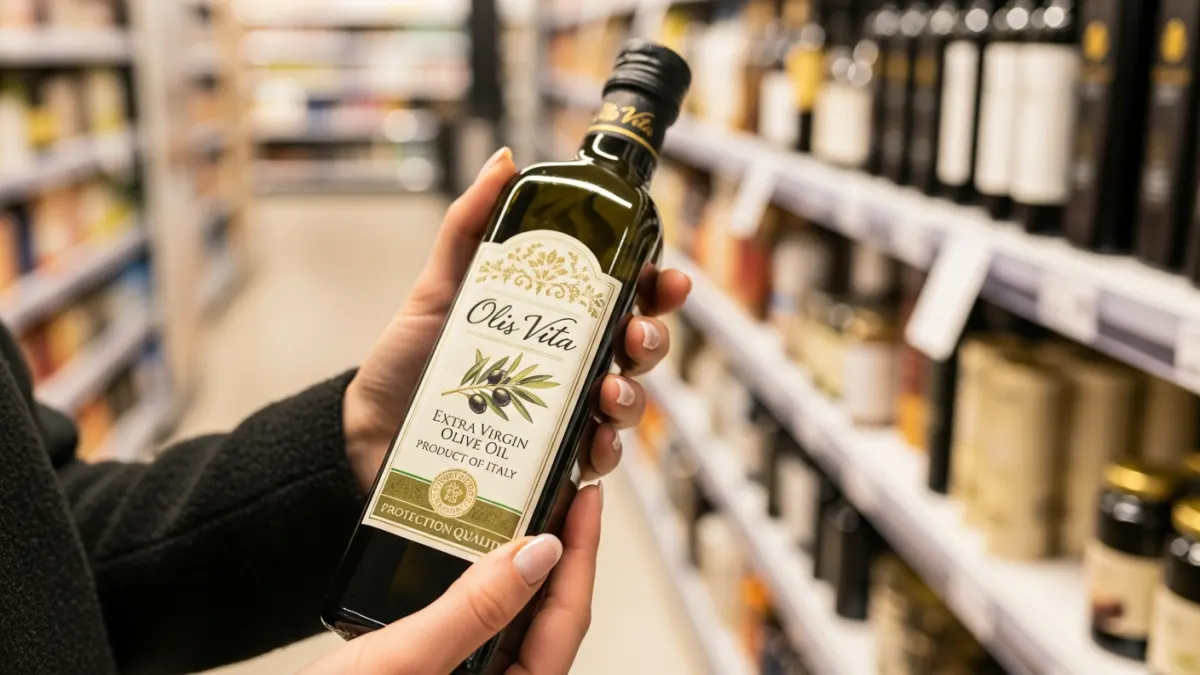
Olive oil is not a product that improves with age – quite the opposite. Freshness is one of the most important quality factors that is often overlooked when shopping in the supermarket. Unlike wine or cheese, there is no maturation that improves the taste of olive oil.
High-quality olive oil is pressed and bottled as soon as possible after harvest. The olives should be processed within a few hours of picking to avoid oxidation and fermentation. The fresher the oil, the more valuable ingredients such as polyphenols, vitamin E, and oleocanthal are still present. These substances are not only responsible for the taste, but also for the health benefits attributed to olive oil.
In the supermarket, olive oil sometimes sits on the shelf for months – sometimes under neon light and at room temperature. This is not ideal. Heat, light, and oxygen are the three greatest enemies of olive oil. Pay attention to the best-before date: The further it is in the future, the fresher the oil usually is. Ideally, the best-before date should be at least 12 months in the future.
Even better: Some producers print the harvest date on the bottle. This is a very good sign of transparency and quality awareness. An olive oil from the current or past harvest season is always the better choice than an oil without a recognizable date.
At home, you should also pay attention to proper storage: Olive oil belongs in a cool, dark place – not next to the stove and not on the windowsill. This way it stays fresh longer and retains its valuable properties.
Tip: Buy olive oil with the most current harvest or bottling date possible. Avoid bottles that have obviously been on the shelf for a long time. Store in a cool, dark place at home.
If you have the opportunity to taste an olive oil before buying – for example in a delicatessen or at a market – take advantage of this opportunity. The taste reveals more about quality than any label.
A high-quality extra virgin olive oil typically has three sensory characteristics that experts refer to as the “three virtues”:
If an olive oil tastes flat, neutral, waxy, or even rancid, this indicates inferior quality or already advanced aging. Such oils have already lost their character and valuable ingredients.
The organic seal is fundamentally a positive signal. It guarantees that synthetic pesticides, herbicides, and artificial fertilizers were not used during cultivation and processing. This is good for the environment, for the soil, and potentially also for consumer health.
However, organic alone is not a guarantee of top taste quality. Even an organic olive oil can consist of a poorly transparent blend of different origins or may have been stored for too long. Conversely, there are conventional olive oils from small producers who practice sustainable farming but do not have organic certification – for example because the costs of the certification process are disproportionately high for small operations.
The best combination is an organic olive oil with clear origin information, traceable production, and the freshest possible harvest date. Then both the ecological and taste criteria are met.
Do you want to get it right on your next shopping trip? Then pay attention to these points:
If an olive oil meets several of these criteria, you are on a very good path. It becomes perfect if you additionally have the opportunity to taste the oil before buying – for example at markets, from direct producers, or in specialized delicatessens.
Recognizing good olive oil in the supermarket is not rocket science. It does not require expert knowledge or extensive research. It is sufficient to pay attention to a few basic things: the correct quality designation, traceable origin, protective packaging, a fair price, and a look at freshness.
Once you understand what matters, you will no longer be fooled by beautiful labels or supposed special offers in the supermarket. And the difference in taste? It speaks for itself. A truly good olive oil transforms a simple piece of bread into a culinary experience – and plain pasta into a dish that tastes of the Mediterranean.
If you are looking for a truly high-quality olive oil that meets all these criteria, it is also worth looking beyond the supermarket. Small producers and direct marketers often offer a quality that is rarely found on the shelf. Perhaps this is the beginning of a completely new relationship with one of the oldest and most valuable foods in the world.
Learn more about how high-quality olive oil is produced – for example through an olive tree adoption in Liguria. And if you want to delve deeper into the world of olive oil, follow us on Facebook for regular tips and insights.
You recognize good olive oil by clear origin information, the designation “extra virgin olive oil,” a dark bottle, a reasonable price, and a best-before date that indicates freshness. Transparency from the producer is another important indicator.
Not necessarily. A higher price can be an indication of more elaborate production and better quality, but is not a guarantee. What matters is origin, processing, freshness, and transparency from the producer.
“Extra virgin olive oil” is the highest quality level. It is extracted exclusively through mechanical processes and may have a maximum acidity of 0.8 percent. It must be free of sensory defects.
Light accelerates the oxidation of olive oil and destroys valuable ingredients such as polyphenols and vitamin E. Dark bottles or canisters protect the oil better from light exposure and thus preserve taste and quality.
Good olive oil tastes fruity, slightly bitter, and has a subtle pungency in the finish. These characteristics are signs of high polyphenol content. A flat, neutral, or rancid aroma, on the other hand, indicates inferior quality.
Organic olive oil guarantees the absence of synthetic pesticides and fertilizers, which is fundamentally positive. However, organic alone is not a quality guarantee. Conventionally produced olive oil can also be excellent if origin, processing, and freshness are right.
High-quality olive oil generally keeps for 18 to 24 months when stored in a cool, dark place and tightly sealed. After opening, it should be consumed within 6 to 8 weeks, as contact with air reduces quality.