Finding good olive oil starts with the label in the supermarket and continues at home with your nose and palate. Dark glass, an Italian flag or a high price does not prove what is inside. Several useful clues taken together, however, can help you choose more thoughtfully.
These nine steps explain what quality categories, origin, harvest information and packaging actually tell you. You will also learn to separate marketing from verifiable claims, compare two bottles fairly and spot possible off-flavours. Neither a label check nor a home tasting replaces professional chemical and sensory testing. The labelling advice below relates to products sold under EU rules.
In this article
1. Good olive oil starts with understanding the quality category
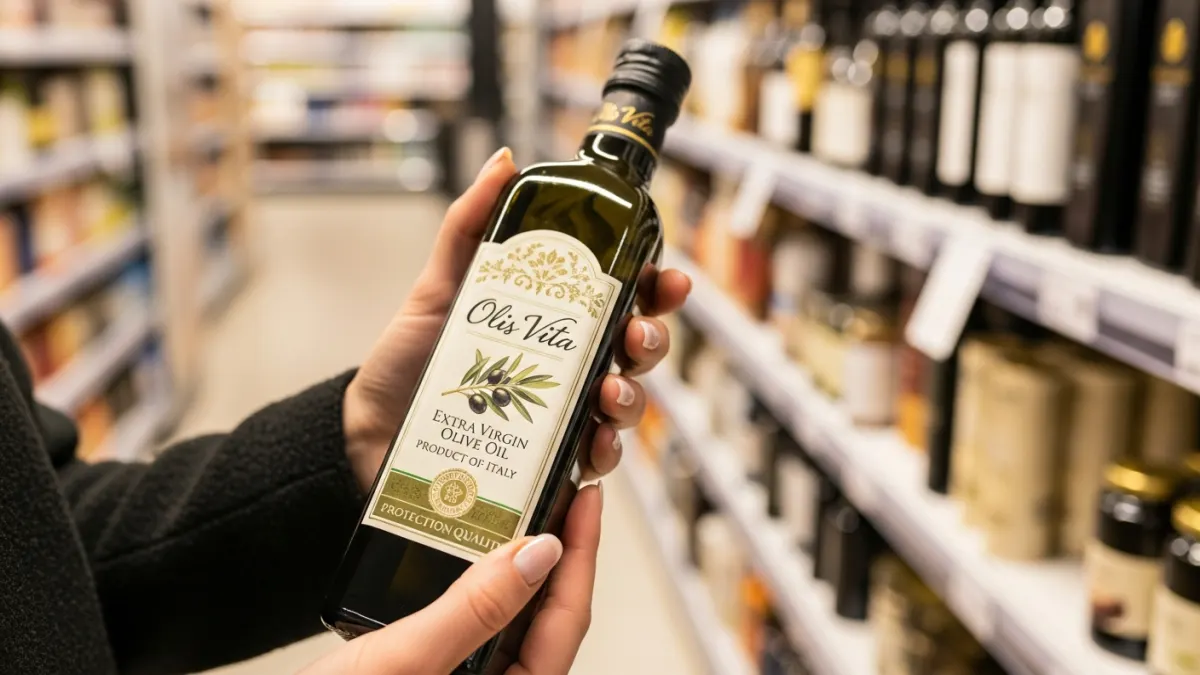
Look for the full legal product name first. “Extra virgin olive oil”, or “olio extra vergine di oliva” in Italian, is the highest legal category. It is obtained solely by mechanical means and must meet specified chemical and sensory requirements. These include fruitiness and a median of defects of zero in the prescribed tasting-panel assessment.
One familiar limit concerns free fatty acids: extra virgin olive oil must contain no more than 0.8 g per 100 g, expressed as oleic acid. This laboratory measurement is not the same thing as a sour-tasting food. You cannot reliably taste the number, and it is not a complete measure of quality on its own.
“Virgin olive oil” without “extra” is a different category. “Olive oil composed of refined olive oils and virgin olive oils” is also a legitimate product, but it is not extra virgin. “Premium”, “Selection” or a picture of an ancient olive tree does not replace the category. The label states what the product must comply with; it cannot fully establish the current condition of an individual bottle.
2. Check origin: bottling location is not olive origin
EU rules require origin information for virgin and extra virgin olive oil. It may identify a country, the European Union or the relevant EU/non-EU origin of a blend. An Italian company address or “bottled in Italy” does not by itself tell you where the olives grew.
A blend from several countries is not automatically inferior, let alone proof of fraud. A carefully made blend can offer good, consistent flavour. A specific producer or origin can make it easier to understand the product and ask questions. Better transparency should not be confused with a guarantee that you will prefer its taste.
Protected designations such as PDO/DOP and PGI/IGP refer to defined origin and production rules. They are different from a decorative national flag. If a designation matters to you, check its exact name and recognised mark. Good olive oil comes from many producing countries; assess the particular product rather than a national stereotype.
3. Separate harvest, bottling and best-before dates
When comparing good olive oil, dates are particularly useful if you distinguish what they mean. A harvest indication relates to the age of the crop. A bottling date tells you when the oil was packaged. Bottling an oil later does not make it younger.
EU rules allow harvest information under defined conditions: all the oil in the container must come from the stated harvest. A harvest campaign can span two calendar years. The information is helpful, but its absence does not prove that the oil is old or poor.
A best-before date is not a harvest date and is not a reliable freshness comparison between brands. It applies to the unopened product under the stated storage conditions. Two bottles with the same date may differ in age and storage history. Look for clear information and consider how quickly you will use the bottle after opening.
4. Judge packaging by protection, not luxury
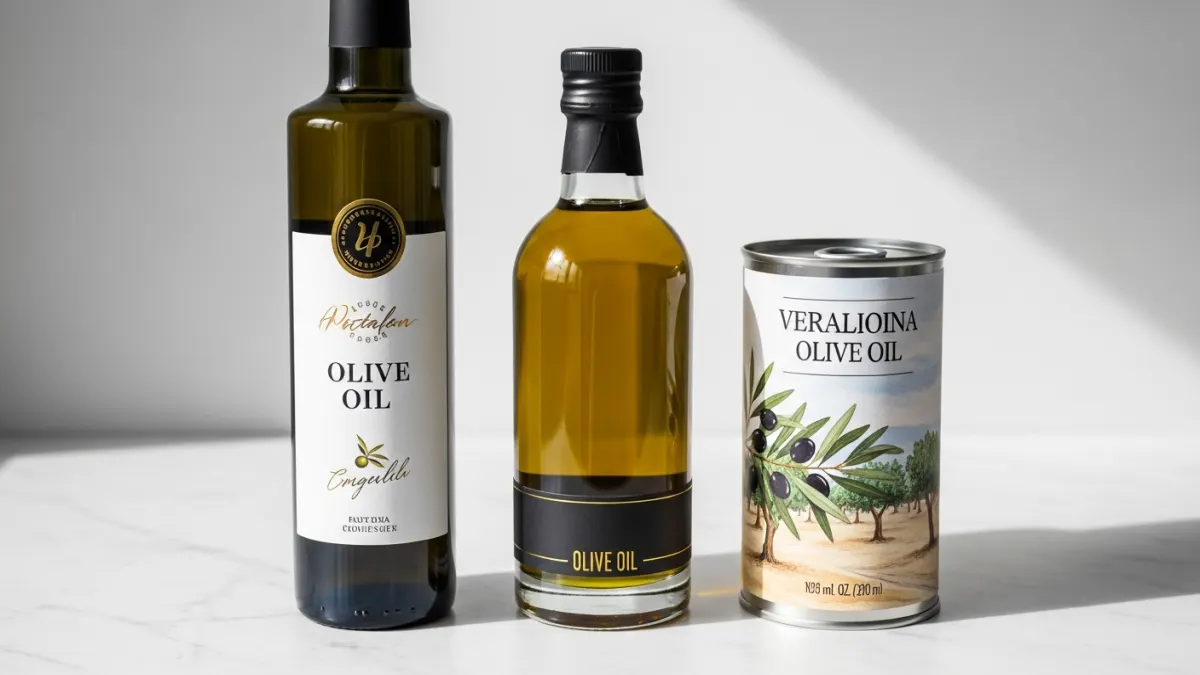
Light, heat and oxygen accelerate olive oil deterioration. Dark glass, suitable metal containers and opaque packaging can help protect it. A heavy ornamental bottle or elaborate gift box tells you little about the original flavour or production.
Check storage in the shop too. Is the oil in direct sunlight or next to a heat source? Is the seal intact? Is the container undamaged? Clear glass is not automatically evidence of poor oil, but it needs particularly effective light protection. An enclosing carton can make a difference.
Choose a size that suits your usage. If you use little oil, 250 or 500 ml may be more practical than a large tin kept open for a long time. A well-sealed tin can make sense for a busy kitchen. Consumption, handling and storage matter more than the idea that one packaging format is always superior.
5. Compare the price per litre without relying on fixed thresholds
Good olive oil has production costs, but there is no permanent minimum retail price below which every offer must be fake. Crop size, farming systems, origin, buying arrangements and promotions all influence prices. A high price does not establish freshness, freedom from defects or suitability for your palate either.
Compare the unit price before judging the offer. A 500 ml bottle priced at €8 costs €16 per litre; 750 ml at €10.50 costs €14 per litre. In this illustrative calculation the larger bottle is cheaper, but it only makes sense if you can use it while it remains in good condition.
For a fair comparison, consider category, pack size and harvest information where available. A recent independent test can add evidence you cannot obtain at the shelf. Check the exact product, batch examined and test date. A top result from years ago cannot guarantee every later bottle of the brand.
6. Put organic, cold extraction and acidity claims in context
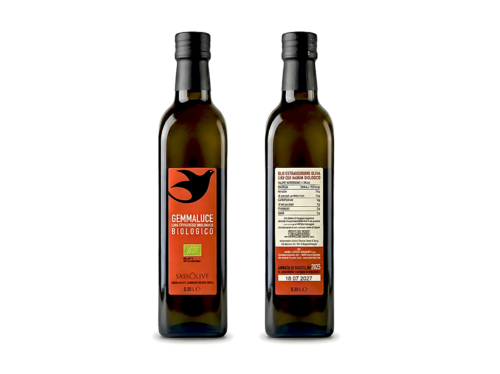
Organic certification is a regulated production standard, not a tasting verdict. Certified organic olive oil may meet your preferences about farming, but when labelled extra virgin it must satisfy the same category requirements as conventional extra virgin oil. The organic mark does not automatically tell you freshness, fruitiness or intensity.
In the EU, “first cold pressing” and “cold extraction” refer to specified processes below 27°C. First cold pressing refers to a traditional pressing system; cold extraction refers to percolation or centrifugation. A modern, cold-extracted oil is not inferior simply because it was not made with a traditional press.
A low acidity figure alone is not proof of exceptional oil. Other laboratory measurements and sensory properties also matter. “Unfiltered” is not automatically an advantage either: cloudiness may reflect suspended material, not higher quality or longer shelf life. Choose meaningful information over the largest collection of impressive terms.
7. Use a simple tasting to explore good olive oil
At home, pour a little oil into a clean, odour-free glass. Cover it briefly with one hand and warm it gently with the other. Swirl carefully, smell it and take a small sip. An ordinary neutral glass is adequate for your comparison; official assessments use standardised conditions.
Fresh aromas may suggest olives, cut grass, tomato leaves, artichoke, herbs, almonds or ripe fruit. Not every good oil has every aroma. A mild, ripe-fruity oil need not have the same intensity as an early-harvest oil with green-fruity notes.
Bitterness on the tongue and pepperiness in the throat can be positive attributes. They are not the same as rancidity, but neither is a standalone proof of high polyphenol content or authenticity. To learn about good olive oil, compare two small samples and then try both on the same plain food, such as bread or a cooked potato.
8. Recognise possible defects and reject unreliable home tests
A clearly rancid impression may recall stale nuts, wax or old fat. Musty, mouldy or fermented, winey-vinegary smells are not desirable fruit aromas either. Do not assume that something described as “intense” is necessarily good: intensity and freedom from defects are separate questions.
A home tasting can reveal something unusual, but it cannot provide an official classification or reliably detect deliberate adulteration. If a newly opened bottle smells or tastes distinctly unpleasant, record the product, batch, best-before date and receipt, then contact the retailer. Do not keep drinking suspect oil simply to complete a supposed test.
Colour and the refrigerator test do not reliably establish authenticity. Different oils become cloudy or solid at different rates depending on their composition. A particularly green colour does not prove high quality. Avoid internet experiments involving flames or other hazards. Reliable findings require suitable analysis and, where relevant, a recognised sensory panel.
9. Preserve quality after buying
Even a carefully selected bottle deteriorates in unsuitable storage. Keep it tightly closed in a dark cupboard, not on a sunny windowsill or beside the cooker. Open it to pour and close it again afterwards.
The International Olive Council recommends container sizes matching roughly one to three months of consumption after opening. This is guidance for preserving quality, not a universal spoilage deadline. Initial quality, packaging, temperature and handling affect what happens. Follow the producer’s storage advice too.
Do not keep topping up old oil in a dirty table cruet. Use clean, food-grade containers that close well. Retain the original information if you decant oil, so origin, batch and dates remain traceable. Your notes can also help you compare the next purchase with the previous one.
Your supermarket checklist for choosing good olive oil
- Category: does the label explicitly say extra virgin olive oil if that is what you want?
- Origin: what origin is declared, beyond the company address or bottling location?
- Age: is a harvest indicated? Do not confuse harvest, bottling and best-before dates.
- Protection: are the packaging and seal intact, light-protective and away from obvious heat?
- Value: does the unit price fit your budget and the quantity match your usage?
- Marketing: can you distinguish useful information from “Premium” and decorative flags?
- At home: does it smell and taste fresh and pleasant, without obvious off-notes?
No single magic feature settles the question. Choosing good olive oil means combining clear labelling, sensible storage and your own taste. Start with a manageable quantity, note your impressions and return to a product that offers both useful information and pleasure at the table.
Frequently asked questions about buying good olive oil
How can I recognise good olive oil in a supermarket?
Check category, origin, any harvest information, protective packaging and a suitable unit price. None guarantees the current condition of an individual bottle on its own. At home, smell and taste complement the label check.
Is an EU blend worse than oil from one country?
Not automatically. A blend from several countries can be well made and taste good. A specific origin helps you understand the product but is not a quality guarantee by itself.
What does acidity of no more than 0.8% mean?
For extra virgin olive oil, this limit concerns free fatty acids expressed as oleic acid. It is a laboratory measurement, not a sour-tasting component. The category also has other chemical and sensory requirements.
Is bitter or peppery olive oil bad?
Bitterness and a peppery sensation can be positive sensory attributes. Distinguish them from rancid, musty or fermented impressions. Mild oil can also be good; intensity alone does not establish quality.
How much should good olive oil cost?
There is no universal minimum price. Compare unit price, category, meaningful product information and, where available, recent independent tests. Neither a promotion nor a high price proves quality or fraud by itself.
Is the best-before date the same as the harvest date?
No. Harvest information concerns the crop or campaign, while bottling concerns packaging. Best-before information relates to the unopened, correctly stored product and does not reliably identify the harvest date.
Does the refrigerator test prove olive oil is genuine?
No. Behaviour in cold conditions depends on composition and is not a reliable authenticity test. Certain forms of adulteration require appropriate laboratory analysis to detect.
Is organic olive oil automatically the best choice?
Organic describes regulated production requirements, not automatically the best flavour or freshest bottle. Consider category, origin, storage and your preferred flavour profile as well.
Sources on labelling and storage
EU Regulation 2022/2104: quality categories, origin and optional labelling
International Olive Council: consumer guidelines for storing olive oil
Explore olive oil flavours and find your preferred pairings
Olive oil for cold dishes: dressings, dips and practical recipes