
Dieter G. Oberg is one of the most influential figures in German-language olive oil sensory analysis. He is the founder of the German Olive Oil Panel (DOP), has headed the Olive Oil Information Association (IGO) in Weßling near Munich since it was established, and developed the sensory evaluation parameter “Harmony” (QHV), now used across the industry.
For more than three decades, Dieter Oberg has shaped the scientific evaluation of extra virgin olive oil in Germany—as a panel leader, lecturer, contractual partner of the EU Commission, and judge at numerous international competitions. His mission: to empower consumers and professionals to recognize quality for themselves—beyond marketing promises.
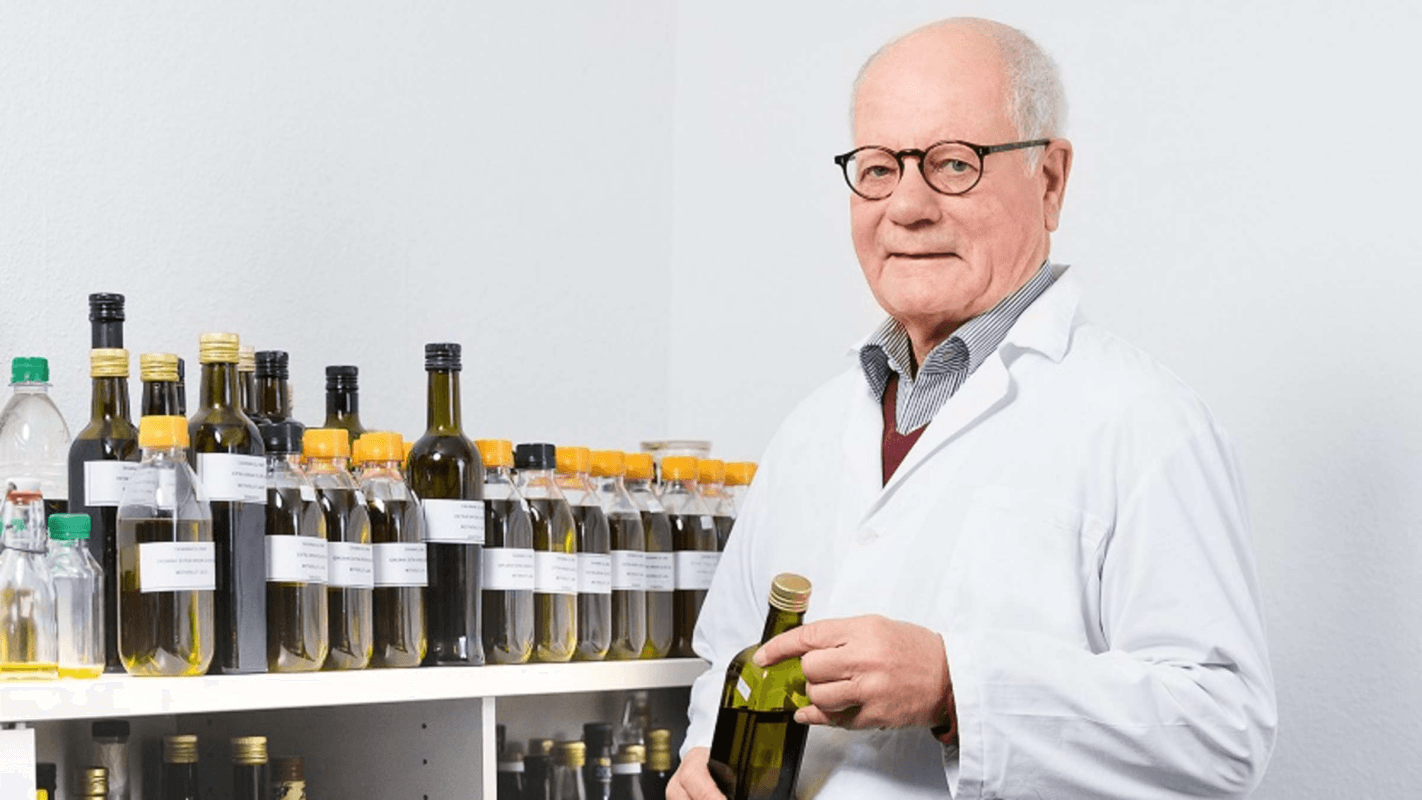
When Dieter G. Oberg founded the German Olive Oil Panel in 1998, there was no standardized way in the German-speaking world to test olive oil sensorially according to the strict requirements of the EU regulation (now Regulation 2568/91 as amended by 2104/2022) and the International Olive Council. With the DOP, he created exactly this infrastructure: a trained panel of qualified tasters that evaluates hundreds of oils each year using reproducible scientific methods—accredited to DIN EN ISO/IEC 17025 by DAkkS and internationally recognized through IOC certification.
For years, DOP results have been used in specialist journalistic tests and consumer guides and are regarded in the industry as the benchmark for serious sensory evaluation in the German-speaking world.
As head of the Olive Oil Information Association (IGO), Dieter Oberg is responsible for the association dedicated to maintaining and promoting the value of virgin olive oils. The IGO collects product-related and nutritional information, conducts independent organoleptic tests using EU and IOC methodology, and makes the difference between premium and low-priced standard oils transparent for consumers. The association’s office is in Weßling near Munich.
One of Oberg’s outstanding scientific achievements is the development of the “Harmony” parameter—part of the Quality Harmony Tasting (QHV). While classic IOC methodology primarily measures an olive oil’s absence of defects, “Harmony” also evaluates the balanced interplay of fruitiness, bitterness, and pungency, as well as the aromatic profile. This makes it possible, for the first time, to systematically capture what distinguishes a truly excellent extra virgin olive oil from a merely defect-free standard oil. Today, the parameter is used across the IGO as an evaluation benchmark.
For 15 years—from 2002 to 2017—Dieter Oberg was a lecturer at ZHAW Zurich for olive oil sensory analysis, introducing entire cohorts of aspiring food technologists and sommeliers to professional tasting. To this day, he runs seminars for importers, the hospitality industry, specialist retailers, and interested end consumers.
As a jury member, he regularly evaluates at international olive oil competitions—his voice carries weight in the European sensory community.
On this blog, Dieter Oberg shares his knowledge on topics including sensory analysis, quality analysis, polyphenols, sensory defects, tasting technique, and the scientific evaluation of extra virgin olive oils. View all posts by Dieter Oberg →
Inquiries about seminars with Dieter Oberg, individual tastings, or expert advice are welcome via our contact form.
{ “@context”: “https://schema.org”, “@type”: “Person”, “name”: “Dieter G. Oberg”, “alternateName”: “Dieter Oberg”, “image”: “https://www.organicfarming-italy.com/wp-content/uploads/2026/05/dieter-oberg-olivenoel-sensoriker.png”, “jobTitle”: “Leiter der Informationsgemeinschaft Olivenöl (IGO), Gründer des Deutschen Olivenöl-Panels (DOP)”, “description”: “Dieter G. Oberg ist Gründer des Deutschen Olivenöl-Panels (DOP, 1998), Leiter der Informationsgemeinschaft Olivenöl (IGO) und Entwickler des sensorischen Parameters „Harmonie\” (QHV). Über 30 Jahre Erfahrung in der Sensorik von nativem Olivenöl extra.”, “url”: “https://www.organicfarming-italy.com/dieter-oberg/”, “knowsAbout”: [ “Olivenöl-Sensorik”, “Deutsches Olivenöl-Panel (DOP)”, “IOC-Standard”, “DIN EN ISO/IEC 17025”, “DAkkS-Akkreditierung”, “Harmonie-Parameter (QHV)”, “Natives Olivenöl extra”, “Polyphenole”, “Qualitätsanalyse” ], “alumniOf”: { “@type”: “Organization”, “name”: “International Olive Council (IOC)”, “url”: “https://www.internationaloliveoil.org/” }, “worksFor”: [ { “@type”: “Organization”, “name”: “Informationsgemeinschaft Olivenöl (IGO)”, “url”: “https://www.informationsgemeinschaft-olivenoel.de/” } ], “memberOf”: [ { “@type”: “Organization”, “name”: “Deutsches Olivenöl-Panel (DOP)” } ] }
Dieter G. Oberg is a German olive oil sensory analyst and a long-standing expert in the sensory evaluation of extra virgin olive oil.
The German Olive Oil Panel was founded in 1998 by Dieter Oberg and serves for the standardized sensory evaluation of olive oil by trained tasters.
In addition to defect-free quality, the parameter developed by Dieter Oberg assesses how balanced the fruitiness, bitterness, pungency, and aromatic profile of an olive oil interact.
He has worked in olive oil sensory analysis for decades, serving as a panel leader, lecturer at ZHAW Zurich, and judge at national and international olive oil competitions, among other roles.
Yes. Dieter Oberg, together with Organic Farming Italy, conducts olive oil seminars where participants gain practical knowledge of quality characteristics and the sensory evaluation of olive oil.