
The European Commission has issued clear guidelines on how olive oil may be classified and marketed. The different olive oil grades give consumers reliable guidance when buying and make it easier to find the right oil for their needs.
The four olive oil grades at a glance
1. Extra virgin olive oil (Extra Vergine)
The highest olive oil grade. The oil is produced directly from fresh olives using only mechanical processes. Taste and aroma are flawless. The free fatty acid content (calculated as oleic acid) may be no more than 0.8 g per 100 g of oil. This grade offers the widest range of flavours—from mild and fruity to robustly bitter to pleasantly peppery.
2. Virgin olive oil
This oil is also obtained purely mechanically from olives, but has minor sensory defects. The fatty acid content is a maximum of 2.0 g per 100 g of oil. Despite slight deviations, this category still offers noticeable flavour variety.
3. Olive oil (blend of refined and virgin)
This product consists of refined olive oil blended with a proportion of virgin olive oil. The fatty acid content is a maximum of 1 g per 100 g of oil. The oil tastes very mild and offers hardly any flavour variation. It is produced when pressed olive oil does not meet the requirements for virgin olive oil grades—then it is refined and subsequently blended with aromatic virgin oil.
4. Olive pomace oil
Olive pomace oil is obtained in a separate production process from the residual oil in the already-pressed olive paste. It contains oil from pomace processing and oil obtained directly from olives. The fatty acid content is a maximum of 1 g per 100 g of oil. This category must be clearly labelled as such on the bottle.
How are olive oil grades determined?
The determination of olive oil grades is regulated by EU Regulation 2022/2104 and is binding for all producers, bottlers and distributors. Quality testing is carried out using two different analysis methods.
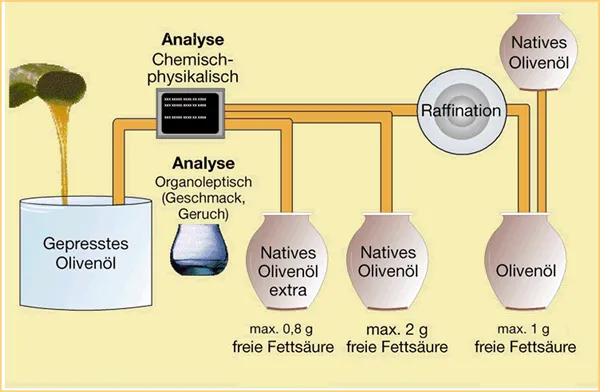
Chemical-physical laboratory analysis
In an accredited food laboratory, a total of 27 different parameters are examined. These include, among others, the free fatty acid content, peroxide value, halogenated solvents, waxes and alkyl esters. There are binding limit and minimum values for each individual parameter. If even a single value fails to meet the prescribed standard, the oil is classified into a lower olive oil grade.
In Germany, the debate about more meaningful testing methods has led to important improvements. Many retailers—especially large supermarket chains and discounters—now have additional parameters analysed that allow more reliable conclusions about the oil’s actual quality. Thermally treated or over-aged olive oils can sometimes be difficult to detect using the current EU standard method.
Checks of diglycerides and pyropheophytins are considered particularly proven. Diglycerides of at least 50–60% and pyropheophytins of a maximum of 7–10% (depending on the season) are regarded as acceptable guideline values. Non-EU countries such as Australia and the USA are also showing growing interest in these extended analysis methods.
Sensory testing by expert panels
For classification into the virgin olive oil grades, sensory testing is decisive. A panel accredited by the respective member state—consisting of 8 to 12 specially trained tasters—assesses the oil for off-flavours as well as positive characteristics such as fruitiness, bitterness and pungency. The intensity is documented precisely.
The official sensory test provides a standardised result: if there is no off-flavour and clear fruitiness is detectable, the oil is classified as “extra virgin”. Many panels only report the classification—without details on positive attributes or the type of defects.
The German Olive Oil Panel goes one step further: it provides information on the intensity of individual attributes such as fruitiness, bitterness and pungency. In addition, an extended test method is used to determine the so-called harmony score—a measure of how balanced and coherent the oil feels overall.
There are undeniably significant quality differences even within the best olive oil grades—especially in taste, aroma, harmony, shelf life and the content of antioxidant secondary plant compounds.
Harmony rating – quality beyond the grade
For each analysis, the German Olive Oil Panel also produces a harmony rating using a method it developed. This is used to quantify quality differences within the best olive oil grades with a statistical value—comparable to the points awarded at international competitions.
The assessment takes into account: the ratio of aroma to taste, the variety and intensity of green or ripe notes, the type and strength of bitterness and pungency, the complex overall impression, as well as consistency and persistence of flavour. The method is based on renowned international olive oil competitions such as Ercole Olivario, the Mario Solinas Award, PremioBiol and Leone d’Oro.
Nuances such as additional flavour notes—such as apple, artichoke, bitter almond or blackcurrant—are included in the overall harmony rating, but are partly subject to the individual testers’ perceptions.
Origin information and labelling
All virgin olive oils must carry an origin designation on the label. Different levels of strictness apply:
- Protected Designation of Origin (PDO / DOP): The olives must be grown, pressed and bottled in an area defined by the EU. The red EU logo identifies these oils.
- Protected Geographical Indication (PGI): At least one production step—cultivation, pressing or bottling—must take place in the specified area. The blue EU logo indicates this.
- Organic certification: Olive oils from certified organic farming carry the organic logo and are subject to strict additional controls.
Oils without a protected regional designation carry more general origin statements such as “from Italy”, “from Greece” or “blend of extra virgin olive oils from the EU”. For blends that contain olive oils from non-EU countries, this must be clearly stated on the label—for example, “extra virgin olive oil from Spain, Italy and Tunisia”.
So it’s always worth taking a close look at the label—including the back—to understand the olive oil’s true origin and quality grade.
You can adopt your own olive tree and experience firsthand everything involved in growing olives: Discover olive tree adoption
Follow our community on Facebook and learn more about sustainable olive farming in Liguria: Organic Farming Italy on Facebook
Important Questions and Answers about Olive Oil Quality Grades
What olive oil quality grades are there?
There are four olive oil quality grades defined by the European Commission. The highest grade is extra virgin olive oil (Extra Vergine) – it is obtained exclusively by mechanical means, is sensorially flawless, and may contain no more than 0.8 g of free fatty acids per 100 g of oil. Virgin olive oil has slight sensory defects and allows up to 2.0 g of fatty acids. Olive oil is a blend of refined and virgin oil with a mild taste. Olive pomace oil is produced from the residual oil in the press cake using a separate process and must be labelled as such.
How is the quality of olive oil tested?
Quality testing is regulated by EU Regulation 2022/2104 and is carried out using two methods. In the chemical-physical laboratory analysis, 27 parameters are examined in an accredited lab, including free fatty acid content, peroxide value, waxes, and alkyl esters. If even a single value fails to meet the required standard, the oil is classified into a lower grade. In addition, an accredited panel of 8 to 12 trained tasters assesses the oil sensorially for off-flavours as well as positive attributes such as fruitiness, bitterness, and pungency.
What does the sensory assessment mean for classification?
The sensory test is decisive for classification within the virgin olive oil grades. If there are no off-flavours and clear fruitiness is detectable, the oil receives the classification “extra virgin”. Many panels only report the classification, without providing details on positive attributes or the type of defects. The German Olive Oil Panel goes a step further and reports the intensity of fruitiness, bitterness, and pungency. In addition, an extended method is used to determine the harmony score, which shows how balanced the oil feels overall.
What are diglycerides and pyropheophytins in olive oil testing?
Diglycerides and pyropheophytins are advanced analysis parameters developed in Germany that allow more reliable conclusions about actual oil quality than some existing EU standard methods. Thermally treated or over-aged olive oils are often difficult to detect with conventional analysis. Acceptable guideline values are diglycerides of at least 50 to 60% and pyropheophytins of no more than 7 to 10%, depending on the season. This method has proven particularly effective in German-speaking countries, and third countries such as Australia and the USA are also showing growing interest in it.
What is the harmony score for olive oil?
The harmony score is determined by the German Olive Oil Panel using a proprietary method and is used to quantify quality differences within the top olive oil grade with a statistical value—comparable to the points awarded at international competitions. The assessment includes the balance between aroma and taste, the variety and intensity of green or ripe notes, the type and strength of bitterness and pungency, the complex overall impression, as well as consistency and persistence of flavour. The method is based on renowned competitions such as Ercole Olivario, the Mario Solinas Award, and the Leone d’Oro.
What do the EU logos PDO and PGI on the label mean?
The red EU logo stands for the Protected Designation of Origin (PDO / DOP). In this case, the olives must be grown in an EU-defined area, pressed there, and the resulting oil must also be bottled there. The blue logo indicates the Protected Geographical Indication (PGI), where at least one production step—growing, pressing, or bottling—must take place in the specified area. In addition, olive oils from certified organic farming carry the organic logo and are subject to strict additional controls.
What should you look for when buying olive oil?
Consumers should check the label carefully—including the back. The origin statement shows where the olives come from: from a Protected Designation of Origin to country statements such as “from Italy”, all the way to blends from several EU or non-EU countries. The grade indicates the quality level, and additional logos such as PDO, PGI, or organic certification provide further guidance. It’s always worth taking a closer look to understand the true origin and quality of the olive oil.
Note: The answers are based solely on the content of this article.