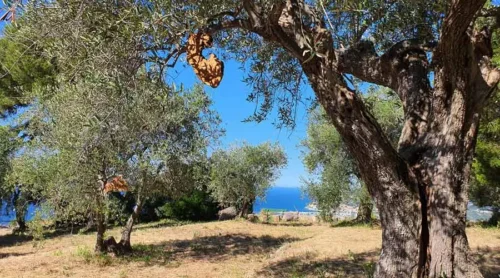
The history of olive oil begins long before the Greek temples and Roman amphorae. It leads to the eastern Mediterranean coast, into Bronze Age workshops, along trade routes to the west, and finally into modern mills on several continents. A laboriously obtained plant liquid became a food, lamp fuel, trade good, and cultural symbol.
This chronology arranges 23 key milestones by period and year. The major dates serve as points of orientation, not as a claim that an entire culture or technique arose on a single day. For early finds, “ca.” means approximately; time ranges reflect the current state of research and regional differences. Compilation as of: 2026.
When was olive oil first documented or mentioned?
Material evidence and written words answer different questions. Among the early indications of olive oil use are residues from Ein Zippori, dated to approximately 6000 BC. The crushed olive remains from Kfar Samir, dating to around 5600–5000 BC, are also especially important for early oil extraction.
The cuneiform archives of Ebla in present-day Syria, from the 24th century BC—roughly 2400 BC—are cited in the literature as an early written mention. Still, “earliest surviving written evidence,” “beginning of cultivation,” and “invention of the oil” are not the same thing. No absolute first use or exact year of invention can be derived from this.
Chronological Overview
ca. 6000 BCFat traces in pottery: oil before writing
At Ein Zippori in Galilee, researchers examined vessel remains whose organic residues are interpreted as evidence of olive oil. The commonly cited dating is around 8,000 years ago, roughly 6000 BC. This suggests that people were already using the olive before written records make it easier for us to look into the past.
Such analyses are something different from a fully preserved oil bottle or a labeled recipe. They rest on archaeological context and chemical traces. That’s why the phrase “among the earliest evidence” is more defensible than the claim that this is where the very first drop in the world came into being.
5600–5000 BCKfar Samir: the fruit is deliberately processed
At the now submerged site of Kfar Samir near Haifa, researchers found large quantities of crushed olive pits and fruit remains. Scholarly literature places these indications of oil extraction at approximately 5600–5000 BC. This brings not just the use of olives into focus, but the actual processing step itself.
People had to break open the fruit tissue and separate the oil from water and solid components. A later screw or hydraulic press is therefore not documented for this early phase. A simple method could already yield oil, even without the sophisticated milling technology of antiquity.
Sources: [1]
5000–4000 BCFrom wild tree to cultivated crop
There is a big step between gathering wild olives and maintaining a permanently managed grove. Archaeobotanical studies and pollen profiles point to early cultivation in the southern Levant. In the fifth millennium BC, deliberate cultivation clearly gains importance there; details and regional focal points remain open research questions.
Planting trees, propagating them, and maintaining them over years means long-term planning. Unlike an annual field crop, an olive grove ties up labor and land across generations. The history of oil is therefore also a history of changing landscapes, horticultural knowledge, and the selection of suitable trees.
Sources: [1]
ca. 2500 BCA Bronze Age production site in Jordan
Khirbet Um al-Ghozlan in present-day Jordan shows how specialized the oil economy could already become. The British Museum report describes a small, fortified facility with processing installations, plant remains, and a striking number of storage vessels. It dates to the early Bronze Age, roughly the period 2600–2000 BC; “around 2500” serves here as a point of temporal orientation.
The combination of finds supports the interpretation as a seasonal production site rather than an ordinary village. Individual investigations, for example into residues in storage jars, were still open in the museum report. This very distinction between a convincing overall interpretation and still-ongoing individual analysis is part of careful historical presentation.
Sources: [3]
ca. 2400 BCEbla: olive oil enters the written record
The palace archives of Ebla, present-day Tell Mardikh in Syria, contain cuneiform tablets from the third millennium BC. The 24th-century evidence relating to olive oil is often cited as a particularly early written mention. Oil is now no longer merely a chemical trace, but an object of administration and commerce.
The record already links the product with control and organized processes. For the question “When was olive oil first mentioned?”, Ebla is therefore an important reference point. The dating refers to a surviving body of writing, not the discovery of the olive and not a globally documented beginning of trade.
1450–1200 BCCrete and the Mycenaean world: oil in palace administration
In the Late Bronze Age Aegean, oil becomes embedded in complex palace economies. Linear B tablets record quantities and uses; one example at the Archaeological Museum of Heraklion lists olive oil offerings to deities at the sanctuary of Amnisos. The period 1450–1200 BC stands for this administrative world documented in writing, not for a single date of origin for all the tablets.
Olive oil was thus more than a kitchen ingredient. Storage, cultic offerings, and processing into fragrant preparations linked agriculture with specialized activities. Crete is an important chapter in this history, but not the sole place of origin supported by the oldest finds.
Sources: [6]
1000–600 BCSeafarers connect the Mediterranean coasts
In the early first millennium BC, Phoenician and Greek trade networks promote the exchange of oil, plants, and cultivation knowledge. Across islands, coastal settlements, and trading posts, the Mediterranean region becomes more closely connected. The expansion of cultivation does not reach different regions of Italy, North Africa, and the Iberian Peninsula at the same time.
A simple chain “first country A, then country B” would be misleading: wild olives already existed in many places, and their use and cultivation developed differently from region to region. What is new is the growing network through which planting material, vessel shapes, craft knowledge, and markets come together.
600–400 BCAthens: food, body care, and a valuable sporting prize
In classical Greek everyday life, oil appears in food, body care, lamps, and ritual. Panathenaic prize amphorae are especially vivid examples: winners of the competitions in Athens received vessels filled with oil from sacred olive groves. The Metropolitan Museum documents such amphorae as early as the sixth century BC.
These prizes should not be equated with the olive wreath of the Olympic Games. Mythological stories about Athena explain the cultural esteem for the olive but do not substitute for a dating of the first oil production. What distinguishes this era is how closely an agricultural product is tied to civic identity and public prestige.
Sources: [8]
200–100 BCCato: crushing and pressing described in writing
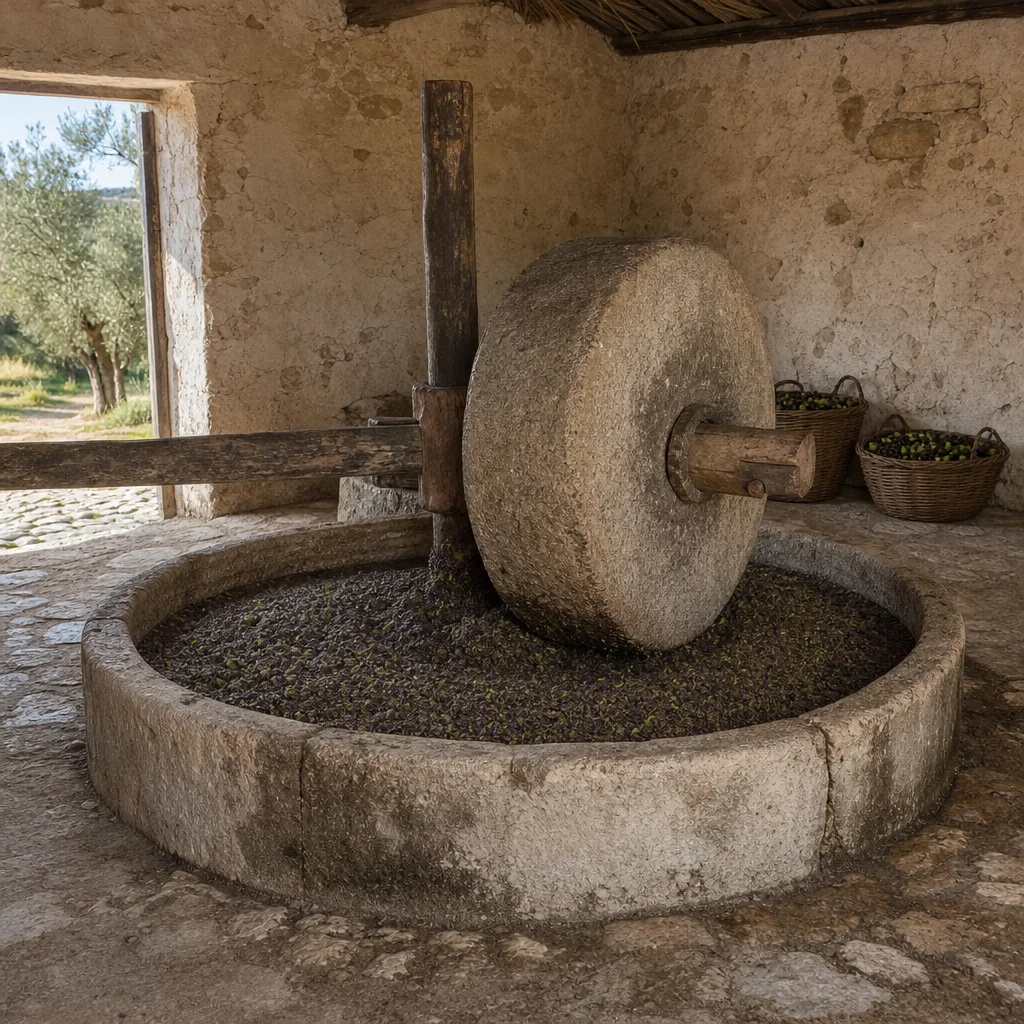
In the second century BC, Cato addresses the running of a farming estate and oil extraction in De Agricultura. Among other things, he describes milling installations and pressing equipment. Stone mills and the crusher known as the trapetum belong to ancient technical history: first the fruit is broken open, then the paste is processed further.
Lever presses use a long beam and additional weight to apply pressure to the olive mass. This mechanical task differs from milling. Cato’s instructions on swift processing also show that harvest organization and oil quality were already being considered together back then—even without modern temperature probes and stainless steel.
1st century AD Pliny and the screw: multiple pressing systems side by side
In the first century AD, Pliny describes pressing mechanisms, including solutions using screws. A screw can transmit force and move a beam or a pressing device. For the history of pressing methods, this is an important written reference point, but not sufficient proof of a single, globally valid year of invention.
Researchers warn against the simple pattern “lever, then screw, then the old press disappears.” Archaeological findings show regionally varying combinations and long periods of parallel use. Small operations, available materials, and local craftsmanship influenced the technology just as much as a new mechanical idea did.
Sources: [10]
1st–3rd century AD Rome: an oil trade that leaves behind a hill
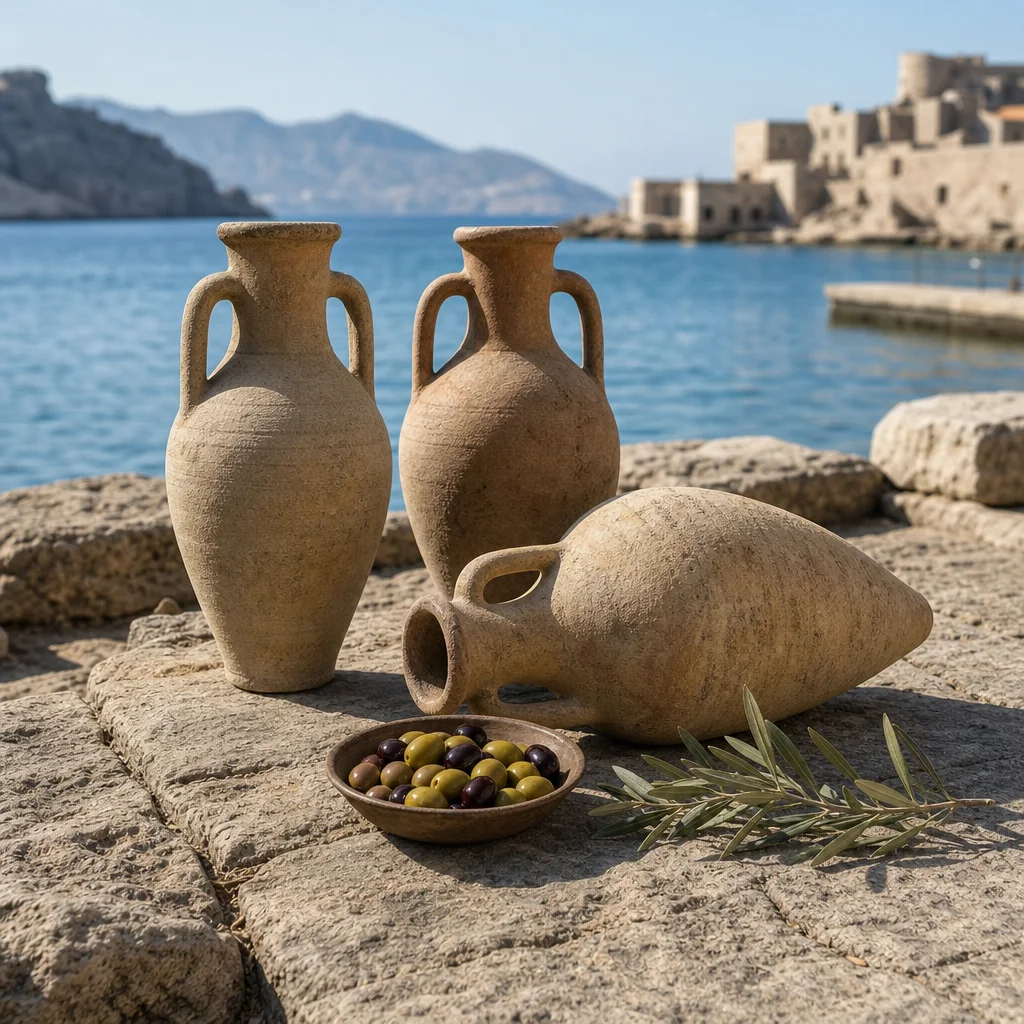
Between the first and third centuries AD, olive oil reaches Rome in large quantities, including from Baetica in southern Spain and from North Africa. Transport amphorae make the product fit for seaborne trade. Inscriptions and stamps could record details of origin, contents, or the people involved.
Monte Testaccio is located in Rome, not Ostia. Its shard material comes predominantly from oil transport vessels and makes the enormous volume of trade visible. In this period, oil is a systematically produced, shipped, and controlled supply good—not merely a precious specialty reserved for a few festive tables.
500–1500Middle Ages: continuity rather than a lost tradition
After the fall of the Western Roman Empire, the olive does not disappear from the Mediterranean region. In Christian, Byzantine, and Islamic-influenced regions, groves, workshops, and trade relationships either persist or are reorganized. Development varies by region; a blanket collapse or a simultaneous upswing everywhere would be too sweeping a claim.
Oil remains important for nutrition, lighting, body care, and religious practice. On the Iberian Peninsula, Arab influence also leaves linguistic traces, for example in the Spanish aceite and the Portuguese azeite. Traditional mills and various types of presses continue to be used over long periods and adapted locally.
16th centuryColonial trade routes bring cultivation to the Americas
In the 16th century, Spanish colonizers transport olive plants to the Americas. Cultivation emerges, among other places, in Mexico, and later in suitable regions of Peru, Chile, and Argentina. This is a longer transfer of plants and methods, not a single date on which an entire continent discovers olive oil.
Climate, water, propagation material, and the organization of the new agriculture are decisive. This cultivation also belongs to the history of European colonization and its effects on existing societies. The fact that a tree of Mediterranean origin takes economic root outside its home region becomes significant for the later world map of olive oil.
Sources: [7]
18th centuryCalifornia: olives at the Spanish missions
In the 18th century, olive trees arrive in California with the Spanish missions. The agricultural overview by Lazicki and Geisseler describes their planting at the coastal missions. This gives rise to a regional chapter of cultivation, from which both table olive and oil production later develop.
A mission’s founding year is not automatically the exact year of the first local oil pressing. That is why this chronology names the century rather than a seemingly certain day. The example shows how worldwide spread consists of many local beginnings, and how differently individual branches of cultivation go on to develop.
Sources: [12]
1795Bramah’s hydraulic patent creates a new technical foundation
In 1795, the hydraulic press is patented by Joseph Bramah. The basic principle uses pressure transmitted through a liquid to generate large forces. The invention initially concerns general mechanical engineering and is not the same as the invention of a fully developed olive oil mill.
For the history of oil, this distinction matters: between a technical principle and its widespread application to a specific fruit lie construction, adaptation, and investment. In the 19th century, industrialization therefore changes not only pressing force but also materials, drive mechanisms, and the division of labor in the mills.
Sources: [13]
1833Montilla: hydraulics are applied to olive oil
A historical-technical study documents, for 1833, the hydraulic oil press installed by Diego de Alvear in Montilla near Córdoba. The machine was manufactured in Manchester and brought to Andalusia. This well-documented example shows concretely how general hydraulic technology was applied to olive processing.
It is not proof that all old presses were replaced worldwide on this day. Hydraulic installations spread gradually and coexist for a long time alongside lever and screw presses. Greater output and shorter processing times can bring advantages; the quality of the oil continues to depend on fruit condition, cleanliness, and organization as well.
Sources: [13]
1951Percolation: another path to oil separation
The AOCS’s technical overview cites 1951 as the year of the Alfin percolation prototype built by Buendía. Here, separation is not achieved solely through strong pressure. The differing wetting behavior of oil and water on suitable surfaces is used for oil extraction.
This principle belongs to the prehistory, or development, of percolation systems; it should not be equated with every later trade name. A new separation method is also no automatic guarantee of quality. It must be considered together with the condition of the olives and the other processing steps.
Sources: [14]
1959An international framework for the olive sector
In 1959, the International Olive Council is founded under the umbrella of the United Nations. The intergovernmental organization, based in Madrid, deals with olive oil and table olives. Shared terminology, technical cooperation, and agreement on quality requirements gain importance for a cross-border market.
This adds the history of standards to the history of the tree and the press. A buyer should not have to judge oil solely by an origin story. Comparable testing procedures and traceable categories become important prerequisites for fair trade and consumer trust.
Sources: [15]
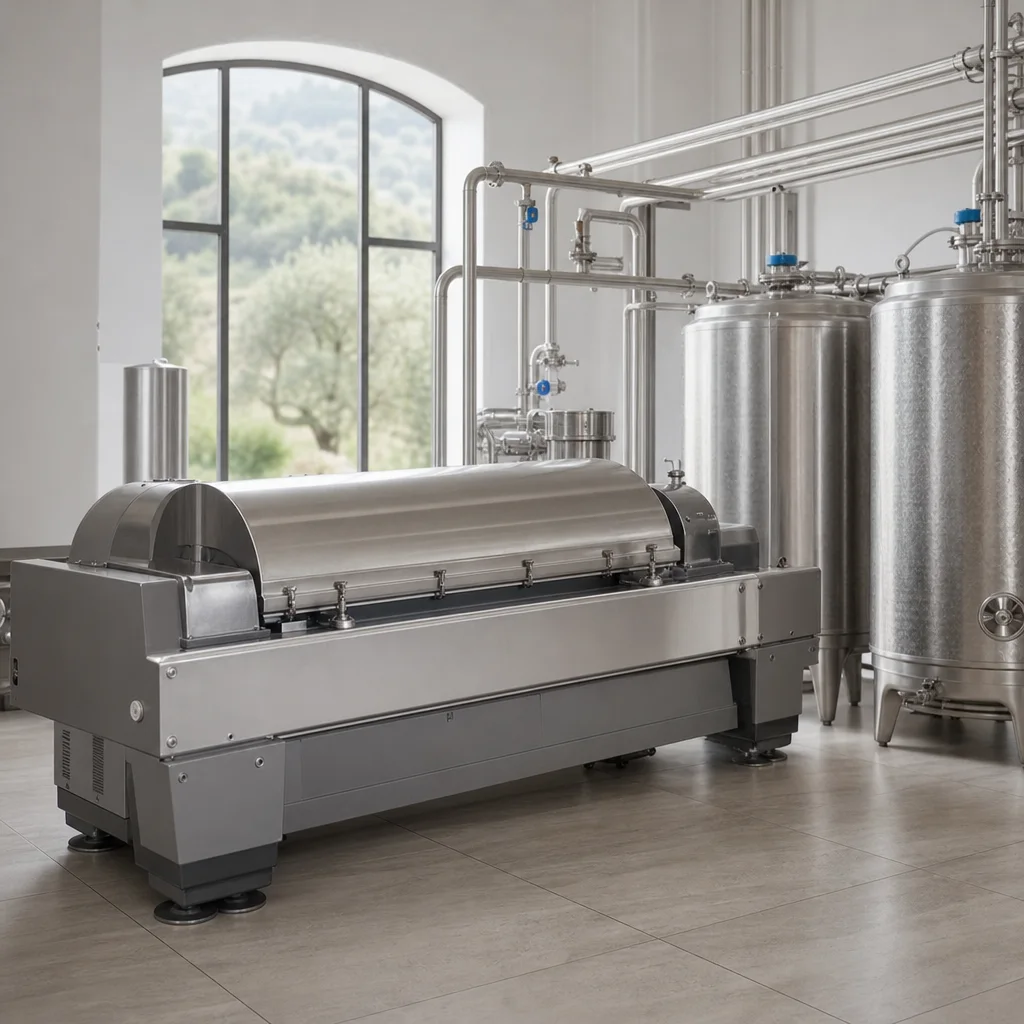
1960s–1970sThe centrifuge changes the mill’s workflow
In the 1960s, industrial, continuously operating decanter lines appear; the AOCS cites the Centriolive system from Alfa-Laval as an example. Centrifugation spreads in the following decades. Instead of organizing the entire separation process through layered pressing mats, components of the olive paste are separated using centrifugal force.
The change affects the workflow: crushing, controlled mixing, and separation can be organized as one continuous line. Presses nonetheless do not disappear abruptly. Even with a modern facility, short transport times after harvest, controlled temperatures, and careful cleaning remain important quality factors.
Sources: [14]
1991Europe refines characteristics and testing methods
Regulation (EEC) No. 2568/91 is an important historical reference point for the characteristics of olive oil and the associated analytical methods. It belongs to the development in which chemical analysis and sensory evaluation are jointly used to classify oil.
This regulation is mentioned here as a historical milestone, not as an unchanged, fully valid legal basis today. Rules are later amended and reorganized. For the history, what matters is that quality is increasingly described through verifiable properties rather than color, price, or a traditional-looking image on the label alone.
Sources: [16]
2013Mediterranean food culture is recognized as cultural heritage
The 2013 UNESCO inscription of the Mediterranean diet encompasses a cross-national culture of growing, harvesting, cooking, and eating together. Olive oil is part of this everyday life in many of the regions involved. What is recognized, however, is not a single oil brand, a remedy, or merely a list of ingredients.
The focus is on knowledge, rituals, hospitality, and the passing on of skills. This links the long history of the landscape with today’s table. Oil remains a food, but it draws its cultural significance from the people and practices that surround it.
Sources: [17]
2022New EU rules regulate marketing and labeling
Delegated Regulation (EU) 2022/2104 consolidates marketing standards for olive oil. These also include conditions for voluntary claims: “First cold pressing” refers to suitable virgin oils obtained from a first mechanical pressing below 27°C using traditional hydraulic presses; “cold extraction” concerns the corresponding extraction by percolation or centrifugation.
This turns a historical technical term into a clearly defined labeling question. A modern extra virgin olive oil therefore does not have to come from a classic press. For consumers, it’s more useful to understand the actual process and the applicable quality criteria than to automatically equate “old” with “better.”
Sources: [18]
2026 · TodayToday: worldwide cultivation and new challenges
Today, olive oil is no longer produced only around the Mediterranean. Growing regions in the Americas and other climatically suitable parts of the world complement the traditional centers. In many modern mills, two-phase or three-phase decanters are in operation; among other things, they differ in how oil, water, and solid residues exit the separation step.
Water availability, heat, disease, variety selection, and the preservation of old groves shape today’s key issues. The history therefore does not end with a perfect machine. It continues in research, changing agriculture, and conscious purchasing decisions. The common thread remains the same: turning a delicate fruit into a good, traceably produced food.
Frequently Asked Questions About the History of Olive Oil
How old is olive oil?
Early residues from Ein Zippori are dated to approximately 6000 BC. The crushed olive remains from Kfar Samir, around 5600–5000 BC, are further important indications of oil extraction. An exact year of invention is not known.
When was olive oil first mentioned in writing?
The literature cites cuneiform tablets from Ebla in present-day Syria, dating from the 24th century BC, as particularly early written evidence. These surviving texts are significantly later than the archaeological indications of oil use.
Did the Greeks invent olive oil?
The known early evidence points to the southern Levant and predates classical Greek culture. Greece and Crete later became important centers for the trade, administration, everyday use, and religious use of oil.
When did screw presses emerge?
In the first century AD, Pliny describes pressing solutions using screws. The exact origin and spread cannot be reduced to a single universally valid year; lever and screw systems were used in parallel for a long time.
Since when have hydraulic olive presses been used?
Bramah’s hydraulic press was patented in 1795. A specific application for olive oil is documented for 1833 in Montilla, Spain. The technology spread gradually and did not replace older installations everywhere at the same time.
When did oil extraction with centrifuges begin?
Industrial continuous decanter lines emerged in the 1960s and spread in the following decades. They separate components of the olive paste using centrifugal force instead of handling the entire process through classic pressing mats.
Where is Monte Testaccio located?
Monte Testaccio is located in Rome. It consists largely of shards from ancient transport amphorae used for olive oil and serves as important evidence of Roman supply networks and long-distance trade.
Why do early stations only have approximate dates?
Archaeological strata, residue analyses, and plant traces often yield time ranges rather than exact calendar years. Cultivation methods and machinery also spread at different rates from region to region. The chronology therefore marks approximations and distinguishes them from securely dated historical years.
Sources and Notes on the Chronology
The numbers at the stations refer to the following sources. Museum object descriptions, archaeological research, historical texts, the history of technology, and current regulations address different questions. Reports of very early finds are deliberately classified as indications or interpretations rather than certainties. The three supplementary article images are illustrative AI-generated images and do not serve as archaeological evidence.
[1] The history of olive cultivation in the southern Levant · Frontiers in Plant Science (2023)
[2] Smithsonian · The Oldest Olive Oil Ever Found Is 8,000 Years Old (2014)
[3] British Museum · Discovering a 4,500-year-old olive oil factory in Jordan
[4] The New Yorker · Olive Oil’s Dark Side (2012), interview with Tom Mueller
[5] The Metropolitan Museum of Art · Ebla in the Third Millennium B.C.
[6] Heraklion Archaeological Museum · Linear B tablet Π-Ν110
[7] International Olive Council · The olive tree
[8] The Metropolitan Museum of Art · Panathenaic prize amphora
[9] Cato · De Agricultura, translated by W. D. Hooper and H. B. Ash
[10] University of Melbourne · A pressing matter: Ancient Roman food technology
[11] Encyclopaedia Britannica · Monte Testaccio
[12] Lazicki & Geisseler · Olive Production in California
[14] AOCS Lipid Library · Olive Oil, García-González & Aparicio
[15] International Olive Council · Mission & Basic Texts
[16] European Union · Regulation (EEC) No 2568/91 (historical)
[17] UNESCO · Mediterranean diet, inscription 2013
[18] European Union · Delegated Regulation (EU) 2022/2104