
Authentic Italian Tiramisu – the dessert that simply comes home
There are desserts you can photograph, garnish, and serve at a Michelin-star level – and then there’s authentic Italian Tiramisu. A cream of mascarpone, eggs, and sugar, a few ladyfingers dipped in espresso, some cocoa on top – done. No frills, no cream, no gelatin. Just a dessert that belongs to Sunday dinner in every Italian family and is so good you’ll want to wipe the plate clean with your finger.
In this Tiramisu recipe, I’ll show you how to truly master this dessert – just like Nonna makes it, like in a trattoria by the harbor, just as it’s simply made in Italy. Tiramisu with mascarpone, with fresh eggs, and with strong espresso. So simple. So good.
What defines an authentic Italian Tiramisu?
If you search for “Tiramisu” in Germany, you’ll find an astonishing number of variations with cream, cream cheese, quark, pudding, or gelatin. All of these have their place – but one thing they are not: an authentic Italian Tiramisu. The true recipe requires exactly these ingredients and no more:
- Mascarpone – the base of the cream. Creamy, mildly sweet, without acidity. Nothing else achieves this consistency.
- Very fresh eggs – egg yolks for the cream, egg whites for the airy structure. No cream needed.
- Fine sugar – not too sweet, so the espresso still shines through.
- Savoiardi – the firm Italian ladyfingers that absorb the espresso without falling apart.
- Strong, cooled espresso – the aromatic backbone of the entire dessert.
- Unsweetened cocoa – generously sifted over just before serving.
- Optional: a dash of Marsala or Amaretto.
Authentic Italian Tiramisu needs no cream, no quark, no gelatin, and no Bourbon vanilla flavor. The creaminess comes from the mascarpone, the volume from the stiffly beaten egg whites, the flavor from the espresso and cocoa. Nothing more is needed – in fact, more would make it worse.
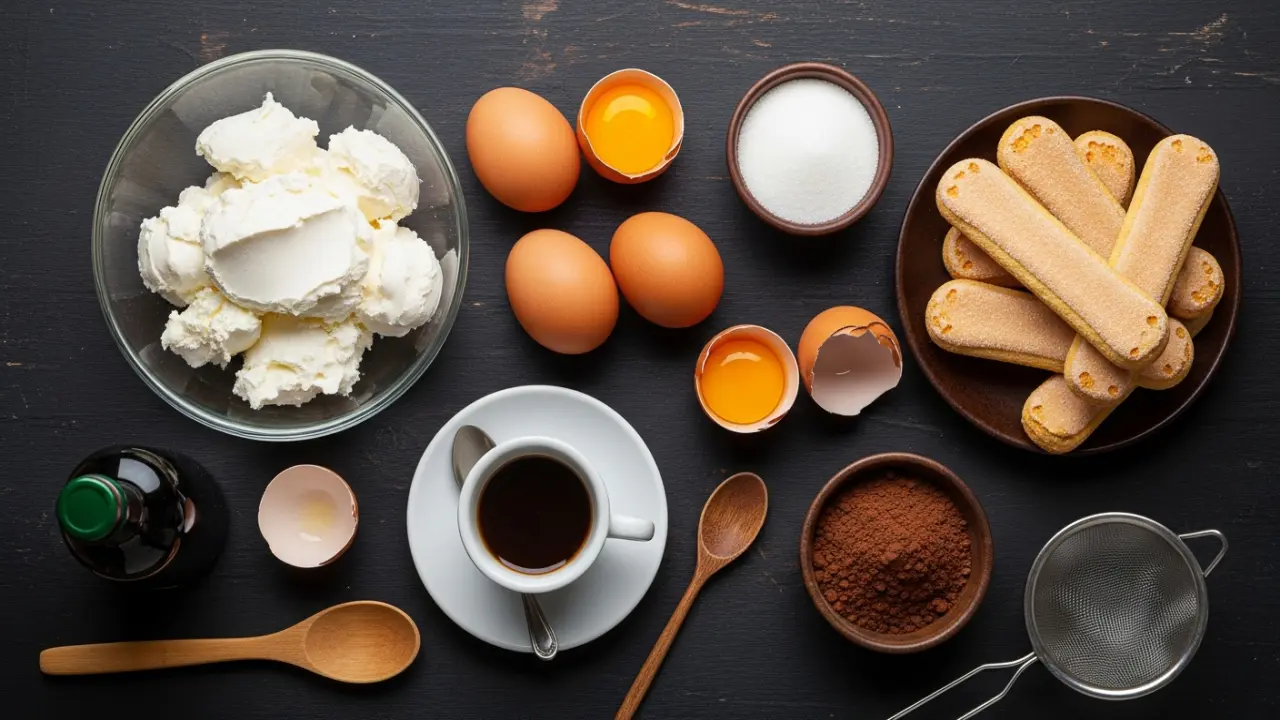
Recipe Profile: Authentic Italian Tiramisu
| Category | Dessert |
| Cuisine | Italian |
| Preparation time | 30 minutes |
| Chilling time | at least 4 hours (ideally overnight) |
| Total time | approx. 4 hours 30 minutes |
| Servings | 6 |
| Difficulty | easy |
| Special feature | without cream, classic with mascarpone |
Ingredients for authentic Italian Tiramisu
For 6 servings (one dish approx. 20 × 25 cm):
| Ingredient | Quantity |
|---|---|
| Mascarpone (fridge-cold) | 500 g |
| Very fresh eggs (Class A) | 4 pieces |
| Fine sugar | 100 g |
| Savoiardi (Italian ladyfingers) | 200 g (approx. 24 pieces) |
| Strong espresso, cooled | 300 ml |
| Unsweetened cocoa | 20 g for dusting |
| Marsala or Amaretto (optional) | 2 tbsp |
| Salt | 1 pinch |
Note on raw eggs: Since the eggs are not heated, they must be absolutely fresh – ideally directly from the farm or at most a few days old. Pregnant women, young children, the elderly, and immunocompromised individuals should avoid raw eggs. A safe alternative can be found below under “Variations.”
Tiramisu Recipe – Step-by-Step
Step 1: Prepare espresso
Brew about 300 ml of strong espresso – preferably in a Moka pot or espresso machine. Pour it into a shallow, wide bowl and let it cool completely. Hot espresso would immediately soak through the Savoiardi and ruin the entire layered structure. If desired, add 2 tbsp of Marsala or Amaretto now.
Step 2: Carefully separate eggs
Carefully separate the 4 very fresh eggs. The egg yolks go into a large bowl, the egg whites into a second, absolutely grease-free bowl. A single drop of egg yolk in the egg white will prevent the meringue from stiffening.
Step 3: Whisk egg yolk cream
Whisk the egg yolks with 70 g of the sugar (the remaining 30 g are for the meringue) using a hand mixer for at least 5 minutes. The mixture should be almost white, very creamy, and noticeably increased in volume. This is the base of the Tiramisu cream.
Step 4: Fold in mascarpone
Add the fridge-cold mascarpone spoonful by spoonful to the egg yolk cream. Do not whisk, but gently fold it in with a rubber spatula. Stirring for too long will make the mascarpone cream runny – this is the most common mistake when making Tiramisu.
Step 5: Beat and fold in egg whites
Beat the egg whites with a pinch of salt until stiff. When soft peaks form, gradually sprinkle in the remaining 30 g of sugar and continue beating until the egg whites are firm and glossy. Using a spatula, gently fold them from bottom to top into the mascarpone cream in portions – never stir, otherwise the air will be lost.
Step 6: Dip and layer Savoiardi
Dip each ladyfinger for only 1 second per side into the cooled espresso – no longer! Savoiardi absorb liquid extremely quickly, and soggy ladyfingers will turn into mush in the dish. Immediately place them in the dish and cover the bottom completely.
Step 7: First cream layer
Spread half of the mascarpone cream evenly over the Savoiardi layer. Smooth it out with an offset spatula or a regular spatula, reaching into all corners.
Step 8: Second layer – and chill
Place the second layer of Savoiardi (again, dip briefly), spread the remaining cream on top, and smooth it out. Cover tightly with plastic wrap (the wrap should not touch the cream) and refrigerate for at least 4 hours, preferably overnight.
Step 9: Dust before serving
Only just before serving, generously dust unsweetened cocoa over the entire surface using a fine sieve. If the cocoa is applied too early, it will absorb moisture from the cream and become sticky and brown instead of velvety. Cut clean portions with a spoon dipped in hot water.
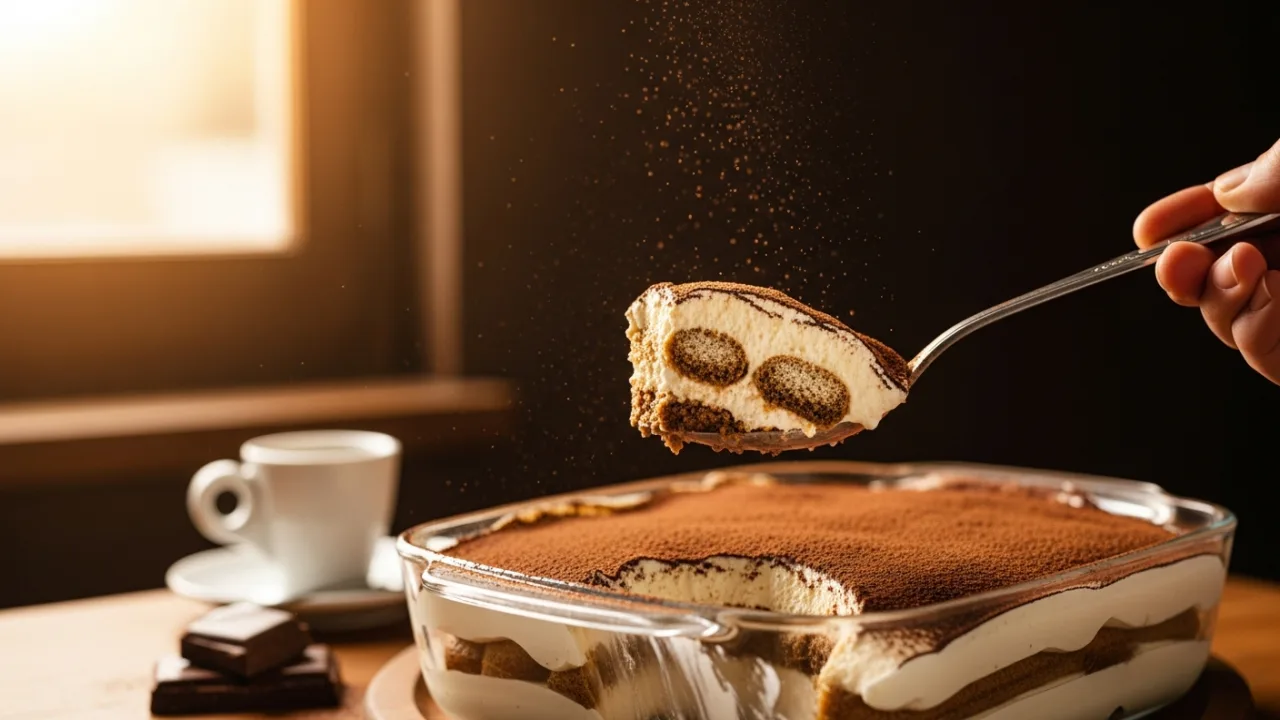
Signora Emilia’s tips for the perfect cream
- Always use fridge-cold mascarpone: At room temperature, it will immediately soften and the cream will become too runny.
- Fresh eggs from the farmer, if possible: Both taste and safety benefit. Rinse the shell briefly under hot water before whisking.
- Espresso must be strong, but cold: A weak filter coffee will make the entire Tiramisu bland. Better to use well-concentrated and properly cooled espresso.
- Do not over-soak Savoiardi: One second per side is enough. When in doubt, shorter is better than too long.
- Fold in egg whites, do not stir: Use a spatula from the outside inwards and downwards – this keeps the air in the cream.
- Cocoa only at the end: Before serving, not before chilling.
- Let it sit overnight: If you have the patience, you’ll get a significantly better Tiramisu. After 24 hours, the flavor is well-rounded and deep.
Common Tiramisu mistakes – and how to avoid them
- Cream becomes runny: Mascarpone processed too warm or whisked for too long. Solution: keep cold and fold in with a spatula.
- Tiramisu falls apart when serving: Chilling time too short. It needs at least 4 hours – no ifs, ands, or buts.
- Savoiardi mush instead of layers: Ladyfingers left in espresso for too long – 1 second per side is enough.
- Watery result at the bottom: Espresso was still warm or egg whites not stiff enough.
- Bitter aftertaste: Espresso too strong without enough sugar, or cocoa applied too early.
- Sticky cocoa layer: Cocoa applied hours before serving – always apply just before plating.
- Egg whites collapse: Traces of fat or egg yolk in the egg whites. Keep bowl and whisk perfectly clean.
Variations: with alcohol, without alcohol, without raw egg
Tiramisu with alcohol
The classic Italian version uses a dash of Marsala – a sweet Sicilian fortified wine – or Amaretto. 2 tablespoons are enough for the entire dish. Add the alcohol to the cooled espresso before dipping the Savoiardi. This distributes the aroma evenly.
Tiramisu without alcohol
Simply omit the alcohol. If you still want depth, add a teaspoon of vanilla extract or a little espresso powder to the mascarpone cream. Family-friendly and without loss of flavor.
Tiramisu without raw egg (for pregnant women, children, seniors)
Whip 500 g mascarpone with 100 g powdered sugar and 250 ml stiffly beaten cream. This variation is not quite the classic Italian Tiramisu – it is creamier and denser – but it is safe for anyone who needs to avoid raw eggs. Pasteurized liquid egg whites from the refrigerated section are another alternative for the meringue.
Tiramisu with fruit
A charming variation in summer: Instead of espresso, dip the Savoiardi in fresh strawberry or raspberry juice and add berries to the layers. Strictly speaking, it’s no longer called Tiramisu, but it tastes great and is especially popular with children.
Frequently Asked Questions about Authentic Italian Tiramisu (FAQ)
Does authentic Italian Tiramisu contain cream?
No. A classic authentic Italian Tiramisu is made exclusively from mascarpone, eggs, and sugar. Cream is a German simplification and dilutes both the taste and the typical consistency.
What alcohol belongs in Tiramisu?
Classically, a dash of Marsala is added to the cream. Amaretto is also frequently used. However, alcohol is not mandatory – an authentic Italian Tiramisu tastes excellent even without it.
Can you make Tiramisu without alcohol?
Yes, easily. Simply omit the alcohol or replace it with a tablespoon of strong espresso in the cream. The dessert loses nothing essential in terms of taste.
How long does Tiramisu need to chill?
At least 4 hours, ideally overnight. This allows the flavors and cream to combine, the ladyfingers to absorb the right amount of espresso, and the Tiramisu to achieve its characteristic, sliceable consistency.
Why does the Tiramisu cream become runny?
Common causes: egg whites not beaten stiff enough, mascarpone stirred too long at room temperature, or the cream was whipped with cold eggs. Gently fold in the mascarpone – do not whisk for long – then the cream will remain stable.
Can Tiramisu be prepared the day before?
Even better: Tiramisu should be prepared the day before. Only after several hours in the refrigerator does its typical well-rounded flavor develop.
Which ladyfingers are best?
Authentic Italian Savoiardi have a firmer, slightly crispier texture and absorb espresso evenly. Soft German ladyfingers often fall apart too quickly. You can find authentic Savoiardi in Italian grocery stores, well-stocked supermarkets under brands like Vicenzi or Balocco, or order them online. If you only have German ladyfingers on hand, dip them for an even shorter time (half a second per side) – otherwise, they will quickly become soggy.
Can you make Tiramisu without raw egg?
Yes. Instead, whip 500 g mascarpone with 100 g powdered sugar and 200 ml stiffly beaten cream from pasteurized egg white substitute. The taste and character are slightly different, but it’s the safer option for pregnant women, young children, or the elderly.
How long does Tiramisu keep?
Well-covered in the refrigerator, 2 to 3 days – no longer due to the raw eggs. Freezing is possible, but noticeably changes the consistency; the mascarpone cream becomes grainier after thawing.
Summary for the recipe box
Carefully prepare mascarpone cream from 4 very fresh eggs, 100 g sugar, and 500 g mascarpone – whisk egg yolks with sugar until frothy, fold in mascarpone, stir in egg whites. Briefly dip 200 g Savoiardi in 300 ml cooled strong espresso, layer in a dish, add cream, then a second layer on top. Chill in the refrigerator for at least 4 hours, preferably overnight, and generously dust with cocoa before serving. Authentic Italian Tiramisu – without cream, without gelatin, without frills.
More from Cucina della Nonna
- Spaghetti Carbonara – authentic Italian recipe
- Minestrone alla Nonna – Italy’s Most Honest Soup
- Mediterranean Diet – the Mediterranean diet in detail
- More recipes from Cucina della Nonna
- All recipes by Signora Emilia
Buon appetito – and tell us how it turned out
Have you tried the Tiramisu recipe? We look forward to your feedback! Write to us or show your result on social media with the hashtag #CucinaDellaNonna. And if you’d like to read more authentic Italian recipes and insights into real extra virgin olive oil directly from Liguria, feel free to visit us regularly – or become part of our small Italian family story with an olive tree adoption.
Where does Tiramisu actually come from?
Tiramisu is – compared to other Italian classics – a surprisingly young dessert. Unlike pasta, pizza, or risotto, whose roots go back centuries, Tiramisu in its current form can be quite clearly attributed to Veneto, specifically the city of Treviso, where it originated in the 1960s and early 1970s. Several restaurants claim authorship – with good arguments, but without conclusive historical proof. What matters is that the recipe spread rapidly throughout Italy and is now indispensable from any trattoria menu.
The name itself is programmatic: Tirami sù literally means “pick me up” – a clear reference to the invigorating effect of sugar, cocoa, and espresso. This exact combination defines the character of an authentic Italian Tiramisu: sweet, but not cloying, creamy, but not heavy, with a fine bitter note from the cocoa and the aromatic espresso. In 2017, Tiramisu was officially recognized in Italy as a traditional food of Veneto (P.A.T.).
Mascarpone – buying the most important ingredient correctly
For authentic Italian Tiramisu, the entire recipe stands or falls with a single ingredient, which for Tiramisu is mascarpone. It gives the cream its texture, its mild flavor, and its characteristic creaminess. When shopping, it’s worth taking a second look at the label:
- Fat content: Real mascarpone has around 40% fat. Light versions or mixtures with low-fat quark taste different and are less stable in the cream.
- Ingredient list: Ideally, only cream (or milk), acidifier (citric acid / tartaric acid). Stabilizers, binders, or added sugar are a bad sign.
- Italian origin: Mascarpone from Veneto or Lombardy (e.g., Galbani, Santa Lucia) generally has the most balanced taste. At discounters, it’s worth comparing ingredient lists.
- Freshness: Always buy mascarpone with a valid expiration date and keep it cool until use. An opened package should be used within 2 days.
Espresso – the aromatic backbone
An authentic Italian Tiramisu thrives on real, strong espresso. Filter coffee, instant powder, or weak capsule brews cannot fulfill the task – the aroma is simply not strong enough to stand up to the sweetness of the cream and the bitterness of the cocoa.
- Moka pot (Bialetti): The classic method in Italian households. Delivers concentrated, aromatic coffee of just the right strength for Tiramisu.
- Portafilter or automatic machine: Also work excellently. Look for a strong blend, preferably with a higher Robusta content – this provides the crema and depth typical for Tiramisu.
- Without an espresso machine: If necessary, brew a double-strength filter coffee (double the amount of powder for the same amount of water) – not perfect, but usable.
Important in any case: The espresso must be completely cooled before you dip the Savoiardi. Warm espresso will cause the ladyfingers to soak uncontrollably and destabilize the entire layered structure.
Savoiardi vs. German ladyfingers – a real difference
Italian Savoiardi – also known as sponge fingers or ladyfingers – differ significantly from many German ladyfingers. They are firmer, crispier, and absorb liquid more slowly. This is precisely crucial for Tiramisu: you want the ladyfingers to absorb espresso but retain their shape, form a recognizable layer, and not disintegrate into mush.
You can find authentic Savoiardi in Italian grocery stores, well-stocked supermarkets under brands like Vicenzi or Balocco, or order them online. If you only have German ladyfingers on hand, dip them for an even shorter time (half a second per side) – otherwise, they will quickly become soggy.
Storage, using leftovers, and preparing for guests
- In the refrigerator: Tiramisu keeps well covered for 2 to 3 days. Do not store longer due to the raw eggs.
- Freezing: Works, but changes the consistency – the cream becomes slightly grainier after thawing. Freeze for a maximum of 4 weeks, thaw slowly overnight in the refrigerator.
- Preparing for guests: Tiramisu is the ideal dinner dessert. Prepare it the day before, chill, and on the day of the meal, just dust with cocoa – done. It hardly gets more stress-free.
- Leftovers: Leftover mascarpone cream tastes excellent for breakfast with fresh strawberries or raspberries. Do not save soaked but unused Savoiardi – they quickly become inedible.
Serving like in an Italian Trattoria
An authentic Italian Tiramisu is usually served directly at the table from a large dish in Italy – not highly styled, but simply scooped into generous portions. If you prefer it more elegant, you can also layer the Tiramisu in individual glasses – then be sure to use narrow, tall glasses so the layers remain visible from the outside.
- Accompaniments: A strong espresso is best – very few Italians drink additional dessert wine with Tiramisu. If desired, serve a glass of Marsala or Vin Santo with it.
- Temperature: Tiramisu tastes best directly from the refrigerator. Do not let it warm up beforehand.
- Clean portions: Dip the spoon briefly in hot water and wipe it dry between portions. This keeps the layers clearly visible.
- Garnish: Classically, cocoa is sufficient. If desired, add a coffee bean, a small mint leaf tip, or grated dark chocolate – but: less is more.
Authentic Italian Tiramisu – the most important points at a glance
- Only six basic ingredients: mascarpone, very fresh eggs, sugar, Savoiardi, espresso, cocoa.
- No cream, no gelatin, no pudding, no cream cheese.
- Alcohol (Marsala, Amaretto) optional – not a must.
- Espresso must be strong and cold.
- Dip Savoiardi only one second per side.
- Always process mascarpone fridge-cold and only fold in, do not whisk.
- Chill in the refrigerator for at least 4 hours, ideally overnight.
- Sift cocoa only just before serving.
- For raw eggs: use only very fresh eggs; when in doubt, choose the raw egg-free version.
If you follow these points, you’ll get a Tiramisu that tastes just like you know it from a good Italian trattoria: creamy, balanced, with a clear espresso note and a fine cocoa finish. Nothing more is needed – and nothing more should really be added.
If you want to delve deeper into Italian cuisine, also check out our other recipes from Cucina della Nonna – or experience Ligurian olive oil directly from the farm with an olive tree adoption. Feel free to follow us on Facebook for ongoing insights from our olive grove in Liguria.